An irrational octal base
01/11/2025
Computers rely on binary digits i.e., 0 or 1. As numbers expressed as 0 and 1 are a pain to write or read and take too many characters anyway, hexadecimal is a preferred base. Hence 22d is rather expressed as 16h than 10110b.
All bases are mathematically defined by:
Where b is the base and ai the digits that must respect ai < b.
b is usually an integer but there is at least one irrational that allows the expression of any natural number as a finite and exact representation!
That magical number is noted φ and famously known as the golden number:
Thus 22d is expressed as 1000101.010001φ which is actually:
Again, numbers expressed in φ base are a pain to write or read and take too many characters anyway. Hence the idea to gather its digits 4 by 4 and express 22d as 45.44hφ.
But behold, in φ base, 11φ = 100φ and thus B-F hexadecimal digits are never needed, neither 3, 6 or 7!
That allows to represent numbers in octaphi base, using only eight digits: 0, 1, 2, 4, 5, 8, 9 and A.
For example, numerunique has existed for more than 2A.04oφ years. Not bad is it?
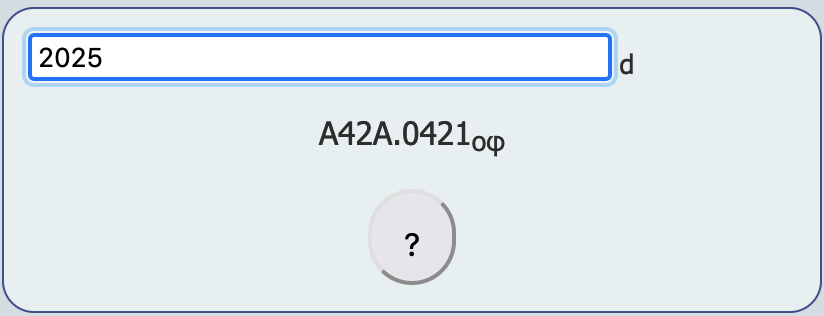
numerunique of course provides a decimal to octaphi converter (click on the image below to access it):
This proposition is based on Burnol's algorithm presented in "The zeckendorf package" by Jean-François Burnol, 2025 https://ctan.org/pkg/zeckendorf. The octal suggestion was also coined by Jean-François Burnol.