
Charge and discharge
11/02/2016
Those who have had the opportunity to monitor the charge and discharge of batteries when their life depended on it know that there are 2 important values:
- the voltage (in Volts) during the use of the battery (discharge),
- the intensity (in Amperes) during recharging.
In practice, the voltage is the good indicator of the battery charge. It decreases slowly at the beginning then more and more quickly when approaching exhaustion. Care must be taken that it does not drop below a certain threshold.
And the intensity is a good indicator of the charge. Very important at the beginning, it decreases more and more to tend towards 0 when the battery is almost fully charged. Below a certain threshold, it is no longer worth waiting longer for an insignificant charge gain.
At the time when almost everything is charged via USB ports, there is therefore a plethora of devices that measure and display these two information and more.
The choice is vast!
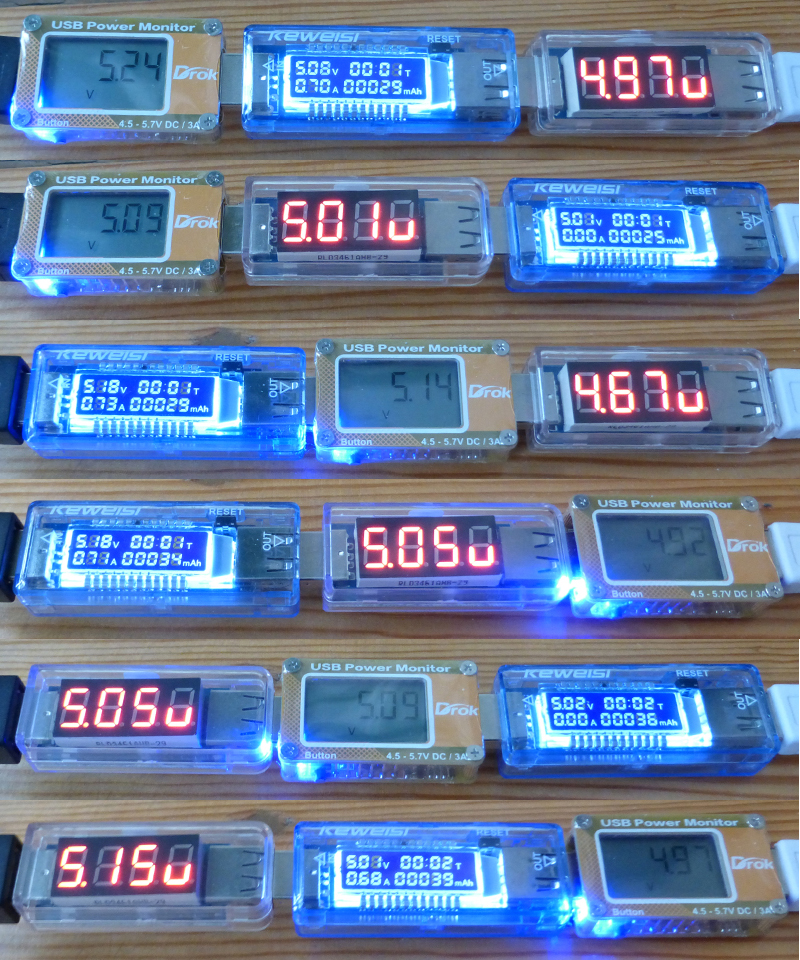
It's the opportunity to compare 3 models:
| Model | Price | Delivery time | V | A | W | mAh | Total mAh | Duration | More |
|---|---|---|---|---|---|---|---|---|---|
| Drok | 15.19 € | 4 | • | • | • | • | • | • | • |
| Keweisi | 10.99 € | 6 | • | • | • | • | |||
| Carchet | 3.61 € | 14 | • | • |
They were all ordered at the same time; the delivery time is the number of days between the order and reception. Yes, it's amusing, the delivery time is inversely proportional to the price.
The first model is the least readable, with a blue diode poorly placed that dazzles more than it illuminates. A button allows scrolling through the information, one at a time. It's also the most complete, the only one to give the instantaneous power (useless) and the duration since the beginning of the charge, to the second (superfluous). In addition, it allows automatically cutting the charge when the intensity has become less than a configurable threshold, which presents a significant safety gain to avoid dangerous overcharge.
The second model is the most readable; everything is displayed simultaneously. Everything is useful. It memorizes the total charge, even unplugged, until you press a button to reset it to zero.
The third model has a display that is too bright which alternates between V and A. The displayed value is quite unstable. It's practical for monitoring the instantaneous power supply of a Raspberry Pi.
All these devices have an unverified accuracy and also consume energy...
You quickly learn some interesting information by using this type of device to monitor the objective efficiency of power supply via a USB port:
- an additional cable used as an extension consumes a non-negligible part of the available power,
- the USB ports of power supplies directly plugged into the mains are the most stable in voltage and amperage and are clearly more powerful than the USB ports of computers,
- the charge absorbed by a battery completely recharged after having been completely discharged is clearly less than its announced capacity. The phenomenon accentuates over time.
And for a geek, it's very trendy.